Category: Uncategorized

  • 48

    July 4th and the Long Road to Inheritance

    In February 2026, I turned 48.

    The celebration was simple: chocolate mousse cake and Poppa chips. No grand ceremony, no spectacle — just a quiet acknowledgement of years lived intensely. Later that same day, an invitation arrived: a farm party in Vågå on July 4th, 2026. The host was Lars Erik Kolden — philosopher, IT manager, and frontman guitarist. Once, long ago, I played drums in his band.

    To understand why that invitation meant something deeper, you have to go back to 1998.

    The Colloquium

    In IN105 at the University of Oslo, we met for colloquium on Simula. Simula — the language that quietly shaped object-oriented programming long before it became mainstream. Inheritance. Polymorphism. Abstraction. These weren’t just technical constructs; they were ways of thinking.

    Lars Erik understood it intuitively. He explained class hierarchies as if they were musical structures. A base class was a rhythm. A derived class — a variation. Override the method, keep the timing. Respect the interface.

    Years later, those early lessons would resurface in my own work. Architecture first. Implementation second.

    GNU/Linux and PHP

    It was also Lars Erik who introduced me properly to GNU/Linux. Not just as an operating system, but as a philosophy: transparency, modularity, freedom. Later, he taught me PHP — and more importantly, how to think about inheritance and polymorphism in practice.

    Code was not just instructions. It was structure over time.

    That mindset followed me into what would eventually become Aamot Research & Innovation.

    The Drummer Who Never Missed Practice

    In 2004, I was working at Elkjøp ASA in Lørenskog. Long commutes. Early mornings. Physical exhaustion.

    At the same time, I played drums at Amatøren in Sogn studentby. Lars Erik was on guitar. Travel distances were long. Energy was limited. But I never missed a band practice.

    Not once.

    Discipline in music mirrors discipline in code. You show up. You rehearse. You refine timing. You improve incrementally. You respect the ensemble.

    The farm party invitation in 2026 was not just a social event. It was continuity. A reminder that the threads from 1998 to 2004 to 2026 are not broken.

    Inheritance

    Inheritance is not only a programming concept.

    We inherit ideas.
    We inherit discipline.
    We inherit friendships.

    Polymorphism, too, has its human analogue. The same person — student, drummer, retail worker, researcher — expressed in different contexts, responding to different interfaces, but retaining core identity.

    At 48, I see the architecture more clearly.

    The colloquium discussions on Simula were not isolated academic exercises. They shaped how I design systems. The band rehearsals were not youthful diversions. They shaped endurance. The long commutes were not wasted time. They shaped resilience.

    On July 4th, 2026, in Vågå, surrounded by music and old friends, I will be celebrating more than a birthday year. I will be celebrating inheritance — technical, musical, philosophical.

    And perhaps that is the quiet reward of persistence:
    the realization that nothing was random.

    Everything compiled.

    — Ole Kristian Aamot
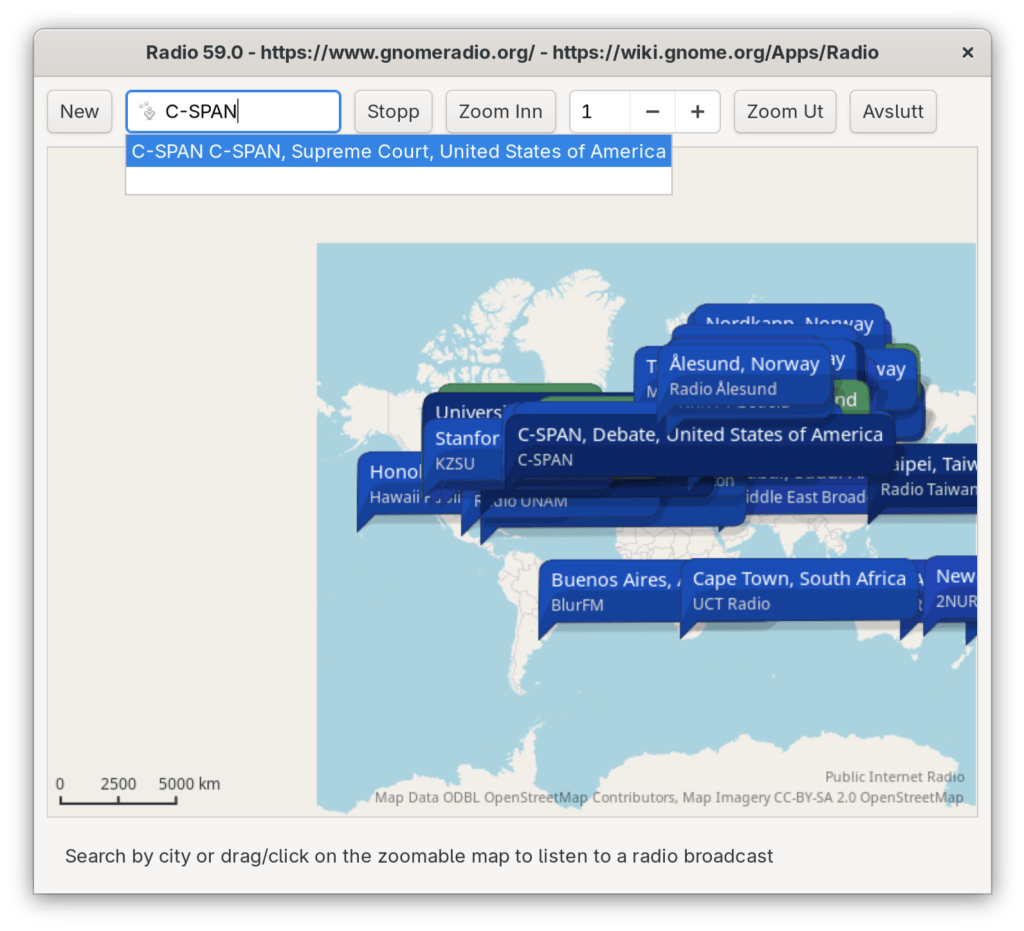
  • 📻 Announcing GNOME Radio 72.0

    Listen freely. Broadcast clearly. Powered by GNOME.

    We’re proud to release GNOME Radio 72.0, the latest milestone in free and open GNOME-based software for real-time radio listening and streaming on GNU/Linux.

    🔗 Source code: https://www.gnomeradio.org/src/gnome-radio-72.0.tar.xz

    🎧 What is GNOME Radio?

    GNOME Radio is a lightweight, GTK-based FM/DAB/Internet radio application designed for users who value freedom, privacy, and clarity in their audio experience. It integrates with the GNOME desktop and leverages GStreamer to deliver high-quality, zero-buffered streaming for real-time radio playback.

    🚀 What’s New in Version 72.0?

    • Updated UI with GTK4 support for better accessibility and GNOME integration
    • Improved station database handling for faster loading and cleaner browsing
    • Zero-buffer streaming engine (Zerobuffer™), offering near-instant audio without lag
    • Enhanced location support to help users find nearby stations using GeoClue2
    • Bug fixes and performance improvements across the board

    🌍 Who is it for?

    • Journalists needing a reliable desktop radio app
    • Students and researchers analyzing live broadcasts
    • Radio listeners who prefer FOSS over proprietary platforms
    • Developers and hackers looking to contribute to open audio ecosystems

    📦 How to Get It

    Clone the source code:

    wget https://www.gnomeradio.org/src/gnome-radio-72.0.tar.xz
    tar Jxvf gnome-radio-72.0.tar.xz
    cd gnome-radio-72.0/
    ./configure --prefix=$HOME/.local
    make
    make install
    $HOME/.local/bin/gnome-radio

    GNOME Radio builds and runs smoothly on Debian 12, Fedora 40+, and Ubuntu GNOME 24.04 LTS.

    🧠 Why it Matters

    GNOME Radio is part of a broader effort to reclaim digital freedom in media technologies. With governments and corporations increasingly centralizing media control, tools like GNOME Radio let users listen without surveillance and connect with the world on their own terms.


    👨‍💻 Developed by Ole Aamot
    📡 Read more and follow updates at: olekaa.wordpress.com
    🆓 Free software under GNU General Public License (GPLv3+)

    Stay tuned, stay free.
    GNOME Radio – Let the airwaves stay open.

  • 🗣️ GNOME Voice 49.0 Released

    Your Voice. Your Data. Your Freedom.

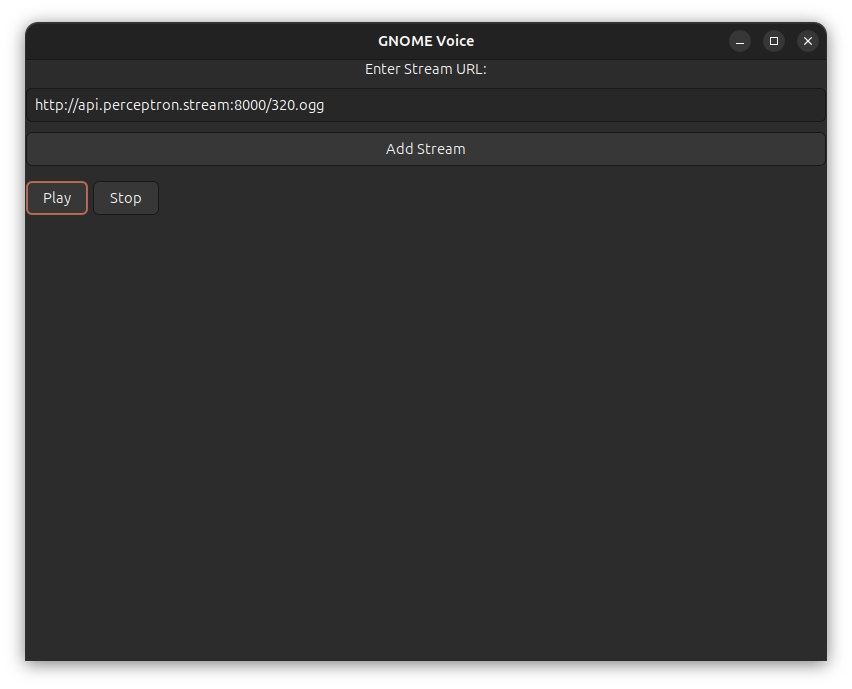
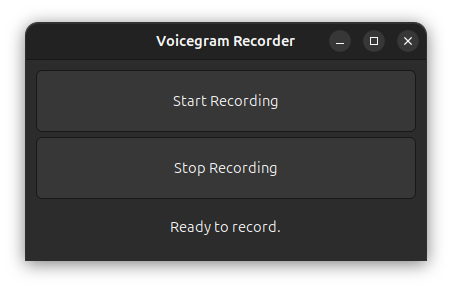
    We’re excited to announce the release of GNOME Voice 49.0, the latest version of our privacy-respecting, speech-focused communication software for GNOME desktops on GNU/Linux.

    🔗 Source code: gitlab.stud.idi.ntnu.no/olekaam/voice.git

    🎙️ What is GNOME Voice?

    GNOME Voice is an open-source voice communication application built using GTK and GStreamer. It enables peer-to-peer audio messaging, live voice conversations, and secure archival of recordings—without the need for centralized servers.

    It’s designed for journalists, whistleblowers, researchers, and anyone who needs a reliable, decentralized voice platform with full control over their audio data.

    🌟 What’s New in GNOME Voice 49.0?

    • 🔒 End-to-end voice encryption with free codecs (Opus, FLAC)
    • 🗂️ Organized audio message storage using Voicegram-compatible metadata
    • 🎧 Low-latency audio streaming with enhanced GStreamer pipelines
    • 🖥️ Modern GTK4 interface for an intuitive, lightweight experience
    • 🛠️ Flatpak-ready for easy distribution and sandboxed use

    📦 Installation

    Clone the repository and build:

    git clone https://gitlab.stud.idi.ntnu.no/olekaam/voice.git
    cd voice
    ./configure --prefix=$HOME/.local
    make install
    $HOME/.local/bin/gnome-voice

    Tested and built on Debian 12, Fedora 40, and GNOME 45+ environments.

    🎯 Use Cases

    • 🕵️ Investigative journalism
    • 📚 Oral history and interview archiving
    • 🎓 Fieldwork and research documentation
    • 🧑‍⚖️ Secure voice communication for legal and civic environments

    💡 Why GNOME Voice?

    Unlike corporate apps that track and harvest your voice data, GNOME Voice puts you in control. Every recording stays on your device unless you choose to share it. With embedded metadata and export to archival XML, it’s also a tool for preserving oral testimony and cultural expression.


    👨‍💻 Developed by Ole Aamot
    🗞️ Read the blog: olekaa.wordpress.com
    🔓 Licensed under GNU GPLv3+

    Speak freely. Archive wisely. Choose GNOME Voice.

  • 🎙️GNOME Audio Locator 4.0.0

    GNOME Audio Locator 4.0.0 Released

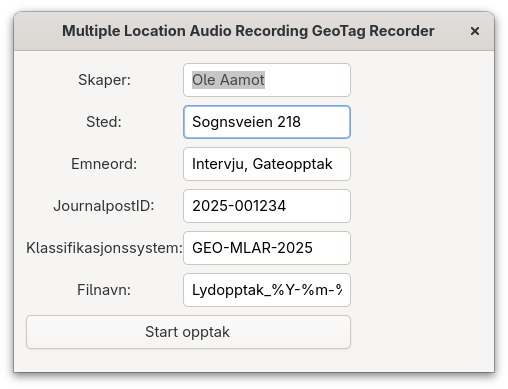
    GNOME Audio Locator 4.0.0 is now available — an important milestone in the development of open-source, geolocated audio recording tools for GNU/Linux. Designed for journalists, archivists, researchers, and developers, this release expands on our commitment to digital freedom, open standards, and location-based audio documentation.


    📍 What’s New in Version 4.0.0?

    • Full support for Multiple Location Audio Recording (MLAR)
    • GEO-MLAR-2025 metadata standard implemented for accurate, archival-quality geotagging
    • Real-time position capture using GeoClue2
    • GTK4-based modern user interface
    • Export to Noark5-compatible XML for public sector integration

    📄 Academic Documentation

    This release is documented in the bachelor thesis:

    📘 NTNU BPROG Article:
    Multiple Location Audio Recording og GEO-MLAR-2025: Spesifikasjon og Implementasjon i GNOME Audio Locator 2.0.0
    by Ole Kristian Aamot, Aamot Research
    🗎 Read the full PDF


    🔧 Source Code & Downloads

    📦 Installation

    Clone the repository and build:

    git clone https://gitlab.stud.idi.ntnu.no/olekaam/gnome-audio-locator.git
    cd gnome-audio-locator
    ./configure --prefix=$HOME/.local
    make install
    $HOME/.local/bin/gnome-audio-locator


    💬 About the Project

    GNOME Audio Locator is part of a broader effort at Aamot Research to democratize audio-based documentation tools through Free Software. Whether you are mapping sounds of protest, preserving local dialects, or contributing to open cultural archives — this tool was made with you in mind.

  • 🎸GarageJam 4.0.0

    GarageJam 4.0.0 Released

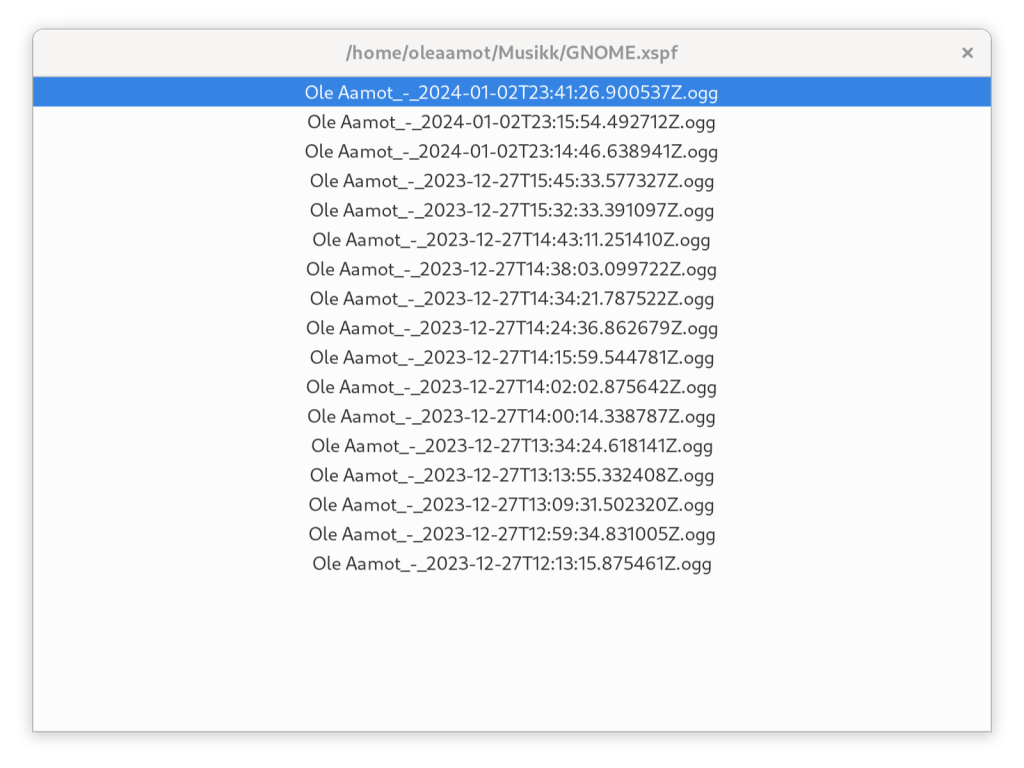
    GarageJam 4.0.0 is now officially released — an open-source music recording and jamming platform built for GNU/Linux. Whether you’re rehearsing in a garage, collaborating remotely, or experimenting with live loops, GarageJam offers musicians a powerful and minimalist toolset to create and share sound.


    🎓 Academic Foundation

    GarageJam is developed in conjunction with academic research into location-based and decentralized audio recording tools.
    📄 NTNU BPROG Thesis:
    Multiple-Location Audio Recording
    by Ole Kristian Aamot
    🗎 Read the full PDF


    🔗 Project Links

    📦 Installation

    Clone the repository and build:

    git clone https://github.com/oleaamot/garagejam.git
    cd garagejam
    ./configure --prefix=$HOME/.local
    make install
    $HOME/.local/bin/garagejam


    🧠 About GarageJam

    GarageJam is part of an initiative to build free and accessible audio software for creators, educators, and sound archivists. With real-time collaboration, metadata support, and GNOME integration, it’s perfect for everyone from solo artists to university media labs.